*Art is not a mirror with which to reflect reality but a hammer with which to shape it with - Bertolt Brecht
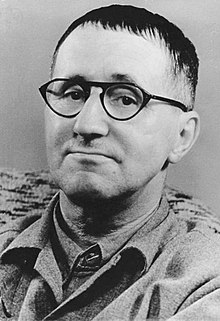
As we shift into term two we change the practitioner which we centre our study and practice around.
We pair the practitioner to the work we do and Brecht matches with Political Theatre very nicely. Bertolt Brecht is a German playwright, poet, director and theatre practitioner. He was born in 1898; he had a middle class upbringing though he sometimes claimed peasant origins. He lived through very radical and scary times (2 world wars, a Russian revolution, the rise of Hollywood etc.). He served as a medical orderly in WW I and was appalled by the atrocities which would influence his later work. Bertolt rejected the ideas of "naturalistic" theatre and decided to find his own methodologies in "Epic Theatre". This kind of theatre disallowed audiences to create an emotional connection with the characters and stories that were being presented; rather it was intended to spark a critical view of the action, analysing the issues and re-evaluating ones own values. Brecht was inspired by many things including; Karl Marx, Chinese Theatre but mostly Political injustice. I feel as if he lived in a time where theatre had become so immersive and "real" that it took the true power away of the art form and he wanted to give the stage it's voice back; and make the audience truly listen. Which lead him to develop -
The "verfremdungseffekt"
This is an alienation technique also known as "strange making" or defamiliarization. It's main goal was to make the audience realise that they are watching a play; to make them snap awake, just when they got comfortable. Brecht believed that in order to truly communicate a message the audience must realise that these are actors; and can no longer be completely lost in the narrative. They can no longer have the illusion of being the unseen spectator. The fourth wall does not exist in Brechtian Theatre; an actor can simply come out of character and talk directly to an member of the audience. I feel like this has the possibility to enhance a piece as the audience are apart of it and will definitely be paying attention if they know there's a chance they can get picked on. Another element of the "V" effect is the use of comedy. If you can make an audience laugh, you can make them cry. It's a really great way of manipulating an audience into reviewing their own morals as you make them realise what they find funny and how dark their psyches really are. However this should be used in effective small doses in order to highlight moments. If it was used for the majority of a play no one would buy it; it would become stupid and would lose all meaning.
Object and attitude exercise
To get us into the style of Brecht theatre we started by walking round the space and pairing a normal object and an attitude and emotion. The first one was a "sexy washing machine". We had to get into a group of 4 and create this contraption. We made sure to make it over the top and crazy; once we matched it with sound and movement it was quite comedic and definitely absurd. The list included a sick toilet, proud chair, depressed sandwich and an angry motorbike. The angry motorbike led into a short improvisation that utilized the "V" effect. In my scene the angry motorbike was paired with an oblivious old lady. I feel as if the contrast created conflict and comedy within the piece and made the audience question the relationship between object and owner. This could be used in a political piece to satirize objectivity materialism and capitalism. There were moments in other pieces such as the actor coming out of role and saying something along the lines of "why won't you start you're not even a motorbike". This really applied the "V" effect as it took you out of this crazy world where a motorbike can talk and also have emotions. I find this exercise useful as it helped me to see how effective this alienation technique can be. A difficult part of this exercise is not over playing the comedy of the situation; I found myself especially only doing things to make the audience laugh which meant I was less focused on the relationship I was creating on stage.
Exaggerated gesture exercise

We were split into two sides and given a simple gesture. My side was given "I dunno" and the other had "stop". We just had to step out and do this gesture and step back in. Simple. We then had to exaggerate it by imagining we had strings on our arms and legs pulling us into the space then do the gesture. It then became a weird and far more interesting gesture. We then gave it a phrase; mine was "Well I didn't make the toast!". The intention became a better, well communicated movement that would be far more entertaining to an audience. The gestures did actually have depth and were very watchable; almost caricatured, clownish but very watchable. Brecht though naturalism was catharsis. It made the audience feel the emotions but ultimately would absolve them and they'd feel better after a good cry. By using exaggerated action and gesture Brecht managed to draw audiences in and keep their attention without losing them to the narrative.
Brechtian Characterisation
For an array of reasons Brecht didn't have big casts and the actors in these kinds of productions didn't have time for deep psychological Stanislavsky style character creations. Subtly and nuance needed to be thrown out of the window. People went from playing "The mother" to the "The post-man" to "The War-lord". All these characters needed to be noticeably different in order for the changes to read in on stage. The first thing you do is find neutral so you have a nice blank canvas to work with. The first character we created was:

- Old man/Old woman - String on nose and bum and then pull them in the different directions, bent knees and chest down. You walk with a shuffle and the add a character voice. For the Old woman you take a "Deutschmark" and stick it where the sun don't shine and hold it there (clench the buttocks). You turn the knees out and add another character voice. Through a hot seating we discovered that these characters read as working class people who led hard working lives.
- Champagne/Special brew drunk - Bent knees, Chin to chest, clench buttocks and hold a champagne class in right hand. The character comes from the object you are holding. So in my minds eyes I pictured a top hat, coat and tails and very posh character appeared. Special brew drunk was the same accept you stick your belly out more and change the object in your hand.
- Pregnant woman - Bent knees, stomach out hands behind lower back, character voice, deep breaths, groans; stereotypes help the character to read on stage.
- Capitalist - Hips out hand on belly and cigar in one hand, similar to champagne drunk, upper class, fat cat pair it with some satirical commentary.
Improvisation: We made all these characters meet in a simple setting (a park) and explored how they all interacted with each other after hearing the news that war has broken out. I found this task hard as with so many strong characters most of the scenes almost always erupted into a cacophony of shouting whilst everyone attempting to input ideas. Some good moments came out of these scenes however. In one scene we saw the characters completely disregard the concept war to focus on their own trivial everyday matters. In another one we got insights into a social commentary about what happens to babies during war times with the reaction of the pregnant woman. These scenes helped us to figure out even through farce and chaos strong obvious characters can deliver important points about society within a piece.
Sources:
http://www.bbc.co.uk/education/guides/zwmvd2p/revision
http://www.gradesaver.com/author/bertolt-brecht
https://en.wikipedia.org/wiki/Bertolt_Brecht


